
Parking can influence a development long before construction begins. It affects site planning, excavation, structural layout, access points, circulation, user experience, and the amount of space available for revenue-generating uses. For developers, the decision is not simply whether to provide parking. The more important question is what type of parking system best supports the project’s site, budget, users, and long-term value.
Two of the most important categories in modern parking design are semi-automated parking and fully automated parking. Both can increase parking efficiency compared to conventional layouts, but they solve different problems and are not interchangeable.
AutoMotion Parking offers solutions in both categories, including the AutoMotion Auto-CP Compact Parker for semi-automated parking and fully automated systems such as the UP System, SP System, LP System, and TP System. Choosing between them depends on how much automation the project needs, how the building will be used, and how much design flexibility the developer wants to recover from the parking layout.
What Semi-Automated Parking Means
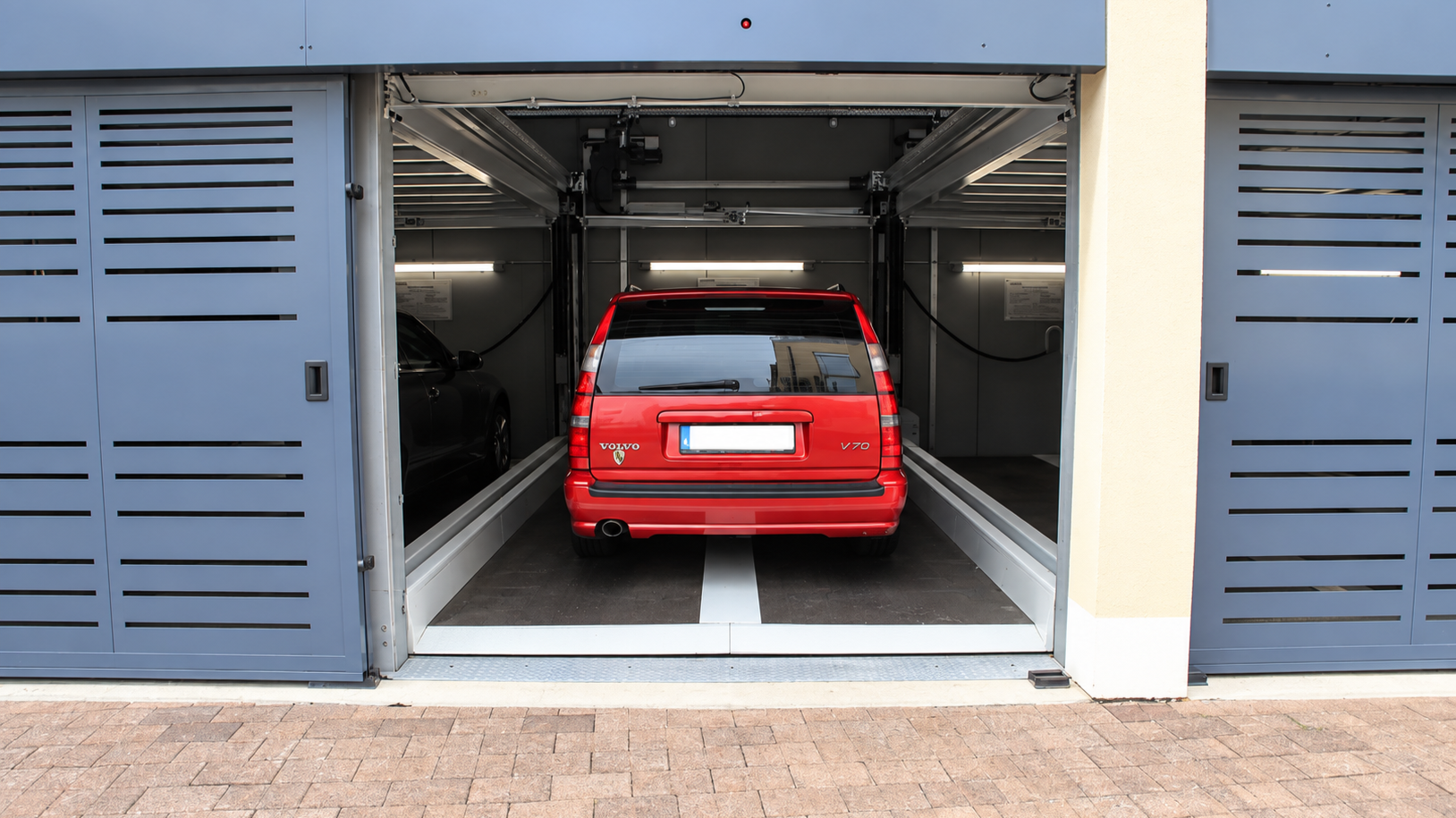
Semi-automated parking is a system where the driver still participates in the parking process, but mechanical or electromechanical equipment helps move vehicles into more efficient parking positions.
In a semi-automated system, the user typically drives into an access area or designated platform. The system then moves platforms horizontally or vertically to create access to the selected space. This allows vehicles to be stacked or shifted in ways that would not be possible in a standard flat parking layout.
AutoMotion’s Auto-CP Compact Parker is an example of a semi-automated system. It is designed to increase parking capacity by stacking vehicles on multiple levels with electromechanical deployment. The selected parking space can move horizontally on grade or vertically on other levels through an automatic control system. Depending on the configuration, Auto-CP can extend parking above grade, on grade, below grade, or as a combined solution.
This makes semi-automated parking especially useful when a developer wants to increase capacity without moving into a fully robotic parking structure.
What Fully Automated Parking Means
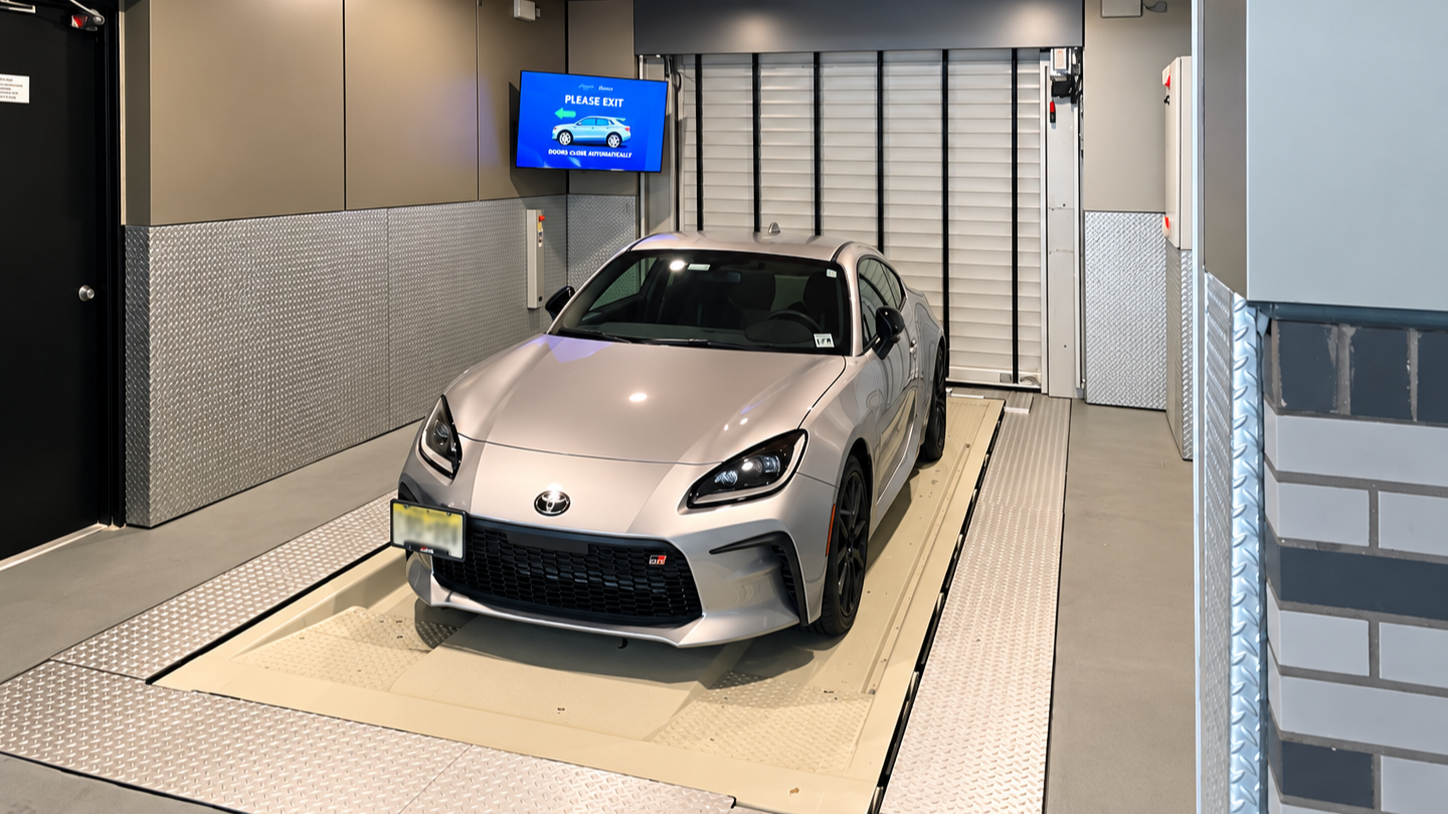
Fully automated parking removes the driver from the vehicle storage area. Instead of driving through a garage, searching for a space, and parking manually, the user drives into a transfer room. After the vehicle is positioned and the passengers exit, the system stores the vehicle automatically.
This creates a major planning difference. In a conventional or semi-automated system, the user still needs some level of access to the parking area. In a fully automated system, the parking area functions more like a storage and retrieval system. Vehicles are moved by lifts, shuttles, pallets, turntables, or storage and retrieval units depending on the system design.
AutoMotion’s UP System is one example of a fully automated solution. It can accommodate up to approximately 100 vehicles with one Storage and Retrieval Unit, depending on configuration, with a maximum system height of approximately 65.7 feet. It can be built above ground, below ground, or as a mixed solution.
AutoMotion also offers other fully automated systems for different site conditions. The SP System is designed for projects requiring a large number of parking spaces and high-volume traffic. The LP System is designed for long and narrow sites. The TP System is positioned for sites with limited surface area and high headroom.
The Main Difference for Developers
The biggest difference between semi-automated and fully automated parking is the level of building design freedom.
Semi-automated parking improves capacity within a more familiar parking environment. It can help developers add more vehicles within a limited footprint, especially in private or assigned parking applications. However, the project still needs user access, a driving lane, and operational space for the system.
Fully automated parking changes the planning model more significantly. Because drivers do not enter the vehicle storage area, the design can reduce the amount of space normally needed for ramps, drive aisles, turning movements, pedestrian paths, and door-opening clearances inside the parking zone.
For developers, this distinction matters. Semi-automated parking is often a strong solution when the project needs more capacity within a defined garage or site area. Fully automated parking is often more appropriate when parking is affecting the entire building plan, land use, excavation, or project feasibility.
When Semi-Automated Parking Is the Better Fit
Semi-automated parking is often the better choice when the project needs more spaces but does not require a complete redesign of the parking strategy.
For example, AutoMotion Auto-CP may be a practical option for residential buildings, private parking areas, assigned parking, or projects where users can adapt to a controlled self-parking process. The system can be used to park up to three cars stacked above each other and can serve configurations from 5 to 38 SUV or sedan vehicles, depending on design.
Auto-CP also uses electromechanical drives and can be operated through RFID or IR/radio remote control. It requires a driving lane in front of the full width of the system and uses one vacant space on the entry level to allow platform shuffling. These details are important because they show that semi-automated systems still need careful operational planning.
For developers, the advantage is that semi-automated parking can increase capacity while remaining relatively compact and user-accessible. It is especially useful when the goal is to improve parking efficiency without creating a fully automated transfer-room operation.
When Fully Automated Parking Is the Better Fit
Fully automated parking is usually the better choice when the project needs maximum space efficiency, stronger design flexibility, or a more controlled user experience.
This is especially relevant in dense urban sites where land is expensive and conventional parking would consume too much of the building footprint. It can also be useful where ramp design is difficult, excavation is costly, the lot is narrow or irregular, or the required parking count is difficult to achieve with a conventional layout.
AutoMotion’s UP System is designed as a universal fully automated solution for office buildings and public parking applications. Its ability to use one Storage and Retrieval Unit for up to approximately 100 vehicles makes it useful for projects that need compact capacity in a controlled automated format.
For larger projects or high-traffic applications, the AutoMotion SP System may be more appropriate. The SP System uses vertical car elevators and shuttles operating on individual parking levels, allowing several hundred parking spaces in above-grade or below-grade configurations.
For long and narrow properties, the AutoMotion LP System provides a different approach. It is designed for sites where width is limited and a longitudinal configuration is more efficient. For projects with limited surface area but high vertical clearance, the TP System may offer another fully automated option.
Comparing Cost, Complexity, and Value
Semi-automated systems are generally less complex than fully automated systems because they do not require the same full transfer-room and storage-retrieval infrastructure. They can be a strong fit when the developer needs improved capacity, but the site does not require the full planning transformation of an automated garage.
Fully automated systems typically require deeper early coordination. The design team must evaluate transfer rooms, vehicle dimensions, system height, retrieval strategy, equipment access, structure, electrical requirements, fire and life safety coordination, and user flow. However, this additional planning can be justified when the parking strategy has a major impact on the building’s footprint, excavation, or rentable and sellable area.
For developers, the decision should not be based only on equipment cost. The better comparison is total project value. A semi-automated system may be the right choice if it solves the parking count efficiently within the existing plan. A fully automated system may create more value if it reduces excavation, recovers usable area, improves the building layout, or allows a difficult site to work.
User Experience Considerations
User experience is another key factor.
Semi-automated parking still feels closer to self-parking. The user interacts with the system and accesses the parking area in a more direct way. This can be suitable for private residential users, assigned spaces, or controlled-access environments where users understand the system.
Fully automated parking provides a more separated experience. The user leaves the vehicle at a transfer room, and the system handles the parking and retrieval. This can reduce the need for users to drive through parking levels, search for spaces, or walk through the storage area.
For hotels, offices, public parking, luxury residential buildings, and mixed-use projects, this controlled arrival and retrieval experience can become part of the building’s value proposition.
The Best Time to Decide
The best time to choose between semi-automated and fully automated parking is during early feasibility planning.
If parking is evaluated too late, the project may already be designed around a conventional garage. At that point, ramp locations, column grids, excavation depth, cores, access points, and building massing may already be fixed. This can limit the benefits of automation.
Early evaluation allows the developer to compare multiple strategies: conventional parking, mechanical stackers, semi-automated systems, and fully automated systems. AutoMotion’s product range gives developers several options depending on whether the project needs moderate capacity improvement, a compact self-parking solution, or a fully automated parking structure.
Choosing the Right AutoMotion Product
For projects that need a semi-automated self-parking solution, AutoMotion Auto-CP is the key product to consider. It is best suited for projects where users can access the system directly and where the goal is to increase capacity through platform movement and multi-level stacking.
For projects that need a flexible fully automated system, the AutoMotion UP System is a strong option. It is designed for up to approximately 100 vehicles with one Storage and Retrieval Unit and can be installed above ground, below ground, or as a mixed solution.
For larger developments or high-volume parking demand, the AutoMotion SP System is designed for a large number of spaces and higher traffic conditions.
For narrow sites, the AutoMotion LP System is designed around a longitudinal layout that reduces width requirements.
For sites with limited surface area and available height, the AutoMotion TP System may be considered as a tower-style fully automated solution.
Conclusion
Semi-automated and fully automated parking both help developers use space more efficiently, but they serve different project needs.
Semi-automated parking is often the right choice when the project needs increased capacity, controlled self-parking, and a more compact solution without fully removing the driver from the parking process. AutoMotion Auto-CP fits this category.
Fully automated parking is the better choice when the project needs maximum layout efficiency, reduced dependence on ramps and drive aisles, a controlled transfer-room experience, or a parking strategy that can reshape the overall building plan. AutoMotion’s UP, SP, LP, and TP Systems fit this category depending on site size, geometry, height, and traffic demand.
For developers, the best choice is not simply the most automated system. The best choice is the system that protects the project’s value, supports the building design, and solves the parking requirement with the least compromise.
That is why parking should be studied early. When the right system is selected at the right stage, parking becomes more than a requirement. It becomes a strategic part of the development.