
Why AutoMotion’s Parking Are Essential for New York City’s Urban Future
Smart vertical parking that frees land, cuts costs and emissions, and unlocks development opportunities across boroughs.
New York City — dense, dynamic and constantly evolving — faces persistent and expensive puzzle parking: limited space, high construction costs, rising curbside conflicts, and growing pressure to reallocate land for housing, transit, and public life. AutoMotion’s modern parking systems — compact, automated, and scalable — offer a pragmatic, proven way to shrink the footprint of car storage, reduce congestion and emissions, and transform parking from a challenge into an asset for developers, building owners, and city planners alike.
The Challenge: Space Is the Scarcest Resource in NYC
New York’s parking inventory is vast in absolute terms but small relative to its land needs. The value of land in the five boroughs makes every square foot critical for housing and commerce. Building conventional parking structures is also costly — with per-space construction often reaching tens of thousands of dollars. The demand for smarter, smaller, and more sustainable parking solutions has never been higher.
How AutoMotion Answers the Challenge
Maximize Capacity on the Same Footprint
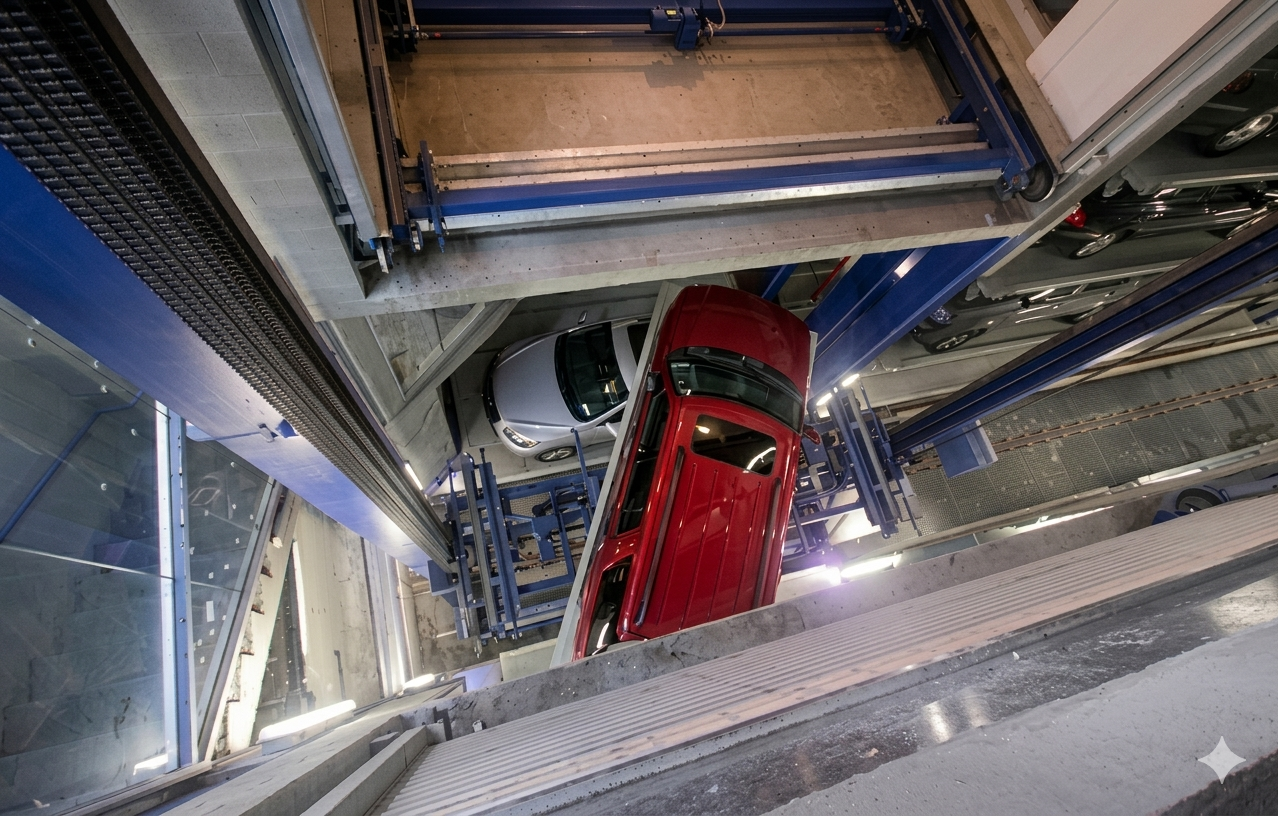
AutoMotion’s automated and stacked systems multiply usable vehicle spaces vertically, often delivering three to six times the capacity of conventional surface lots on the same plot. This makes parking infrastructure far more efficient in tight urban spaces.
Lower Total Project Costs When Land Is at a Premium
While automated systems have higher upfront equipment costs, they save developers significant money by reducing the need for costly land acquisition and by freeing more space for revenue-generating functions such as apartments, retail, or offices.
Reduce Cruising, Congestion, and Emissions
Automated retrieval eliminates time spent circling for parking. Vehicles are stored and retrieved with precision, cutting unnecessary engine idling and reducing local air pollution — an important contribution to New York’s environmental goals.
Improve Safety and Reliability
AutoMotion’s enclosed and sensor-controlled systems reduce pedestrian–vehicle conflicts and eliminate dark, multi-level ramps. Vehicles are stored securely, and advanced fire-safe layouts, emergency protocols, and mechanical redundancies ensure reliability and peace of mind.
Strategic Fit for NYC’s Planning Goals
AutoMotion’s approach aligns with New York City’s broader mobility and development policies — emphasizing sustainability, density, and efficient land use. As the city rethinks parking minimums and prioritizes transit-oriented development, automated parking allows projects to meet practical parking needs without sacrificing valuable buildable area. This balance supports housing growth, greener streets, and smarter mobility infrastructure.
Realistic, Flexible Deployment Models
Infill for new residential or mixed-use towers: Systems can be built into podiums or underground levels to preserve leasable space.
Retrofits for aging garages and lots: Mechanical stackers can increase capacity without expanding building footprints.
Public–private partnerships: Ideal for municipal lots, institutional campuses, and transit hubs seeking compact, high-throughput parking solutions.
What AutoMotion Brings to the Table
Engineering optimized for urban loads and local code compliance
Integration with EV charging, building management, and payment systems
Comprehensive lifecycle support for installation, maintenance, and safety certification
AutoMotion delivers more than parking — it provides an adaptable platform for the evolving mobility ecosystem of New York City.
In A Nutshell — A Pragmatic Tool for NYC’s Future
AutoMotion’s parking systems are a powerful, practical solution that helps New York do more with less: less land dedicated to parking, fewer vehicles cruising for spots, lower per-space costs, and more space for housing, business, and community.
For developers, planners, and building owners seeking to build smarter, denser, and more sustainable projects — AutoMotion is an essential partner for the city’s urban future.
Resources & References
New York City Department of City Planning – Comprehensive Parking Inventories https://www.nyc.gov/site/planning
Urban Land Institute (ULI) – Urban Parking and Development Case Studies https://uli.org
U.S. Department of Transportation – Parking Reform and Emissions Reduction Guidelines https://www.transportation.gov
Technical Review of Automated Parking Systems – Automation and Urban Infrastructure Journal https://www.sciencedirect.com