
Counting the Returns: How Semi-Automated Parking Improves Developer ROI
From reduced construction costs to higher rental yields, SAPS redefines the economics of urban parking investment.
Parking is often viewed as a cost center rather than a revenue engine — but semi-automated parking systems are changing that calculus. Developers investing in SAPS can unlock higher returns on investment (ROI) through construction savings, space optimization, and premium market positioning.
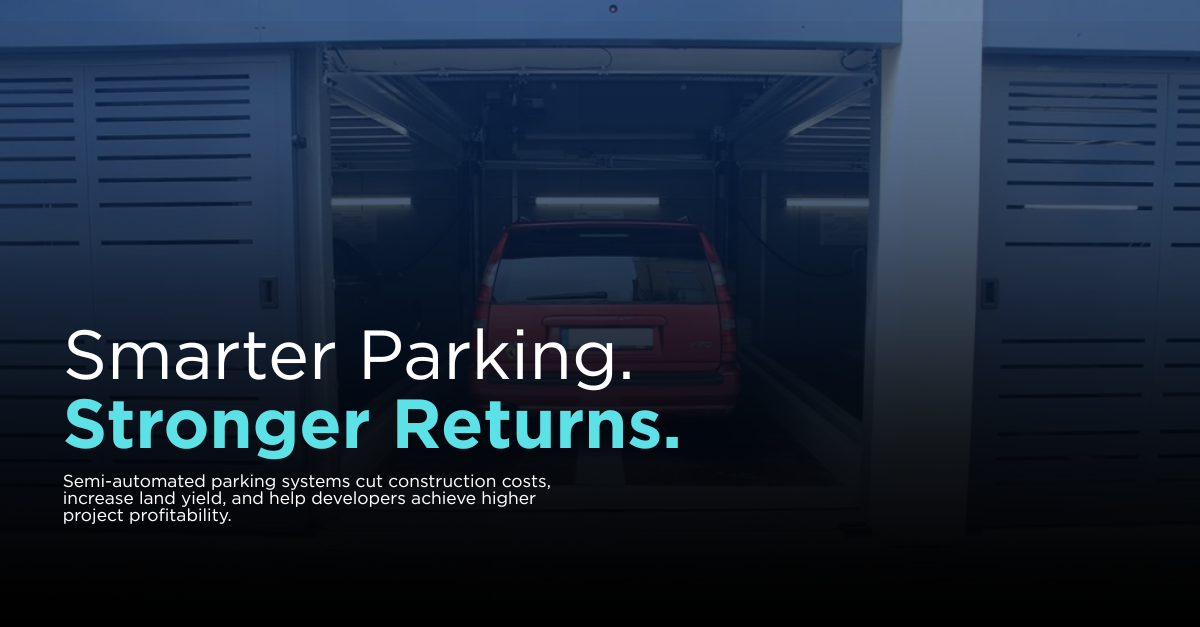
A 2022 Building Design + Construction survey found that automated and semi-automated garages can reduce construction costs by 20–25% due to smaller excavation volumes, less concrete and steel, and lower mechanical ventilation requirements. When combined with higher land yield from reduced space needs, ROI improvements between 8% and 15% are commonly observed within the first five years.
Beyond cost savings, SAPS elevates project desirability. Tenants and buyers often perceive automated parking as a luxury amenity, allowing developers to command 3–7% higher rent premiums in mixed-use and residential buildings. The efficiency also shortens construction timelines — smaller footprints and modular system installations often reduce project delivery times by several months.
Operationally, maintenance and staffing costs decline as fewer personnel are required to manage the garage. Integration with digital payment and access systems further enhances long-term profitability.
In a nutshell:
Semi-automated parking is not just a smarter way to park — it’s a strategic investment multiplier. By compressing spatial needs, cutting build costs, and enhancing property value, developers achieve higher yields while offering superior tenant experience.

References:
Building Design + Construction, 2022 Parking Systems Cost Benchmark Report
Urban Land Institute (ULI), Economic Performance of Smart Infrastructure, 2023
ASCE, Smart Mobility Infrastructure Economics Study, 2022